
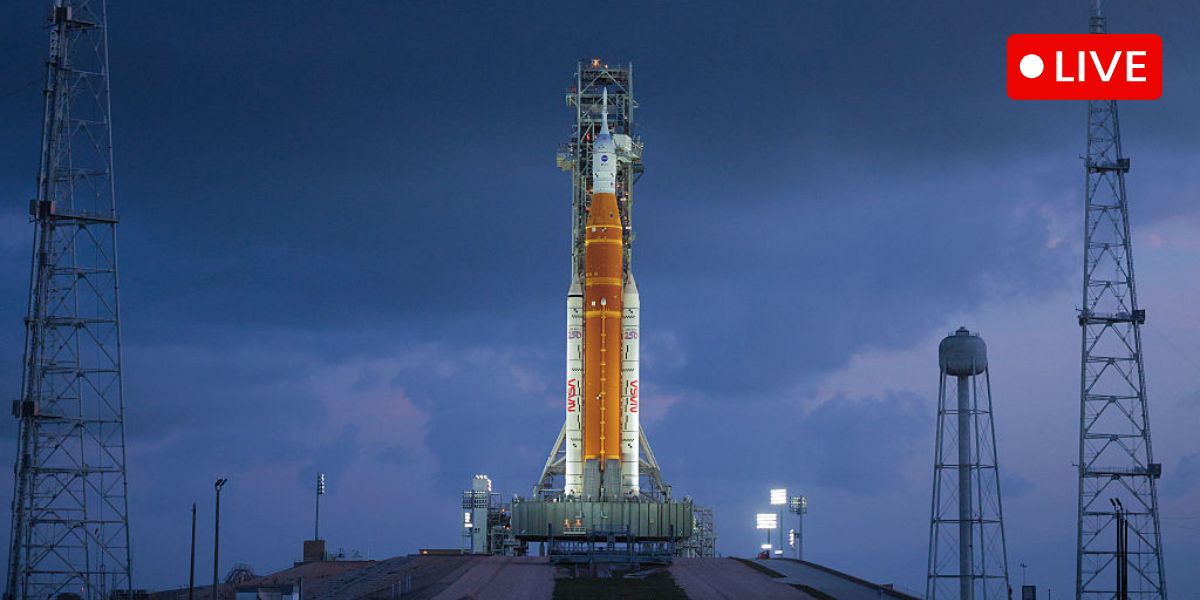
For the first time in more than half a century, humans are heading to the Moon. NASA’s Artemis II mission is targeting liftoff at 6:24 PM EDT on Wednesday, April 1 (8:24 AM AEST Thursday) from Launch Complex 39B at Kennedy Space Center in Florida. The weather forecast is sitting at an 80 per cent chance of favourable conditions, and after years of delays, hydrogen leaks, and heat shield investigations, the moment has finally arrived. It will be the first crewed mission beyond low Earth orbit since Apollo 17 in 1972.
The four person crew consists of NASA astronauts Reid Wiseman (commander), Victor Glover (pilot), and Christina Koch (mission specialist), along with Canadian Space Agency astronaut Jeremy Hansen. The mission will set several firsts: Koch will be the first woman and Glover will be the first person of colour to travel toward the Moon, while Hansen becomes the first non-American to make the journey. Their 10-day, 685,000-mile voyage will take them looping around the Moon before splashing down in the Pacific Ocean off San Diego. They won’t land on the surface; that milestone is earmarked for 2028 under Artemis IV.
Australians can catch the entire event live without needing a cable subscription. NASA’s YouTube channel begins streaming tanking coverage from 7:45 AM EDT (9:45 PM AEST Wednesday night), with full countdown coverage on NASA+ from 12:50 PM EDT (2:50 AM AEST Thursday). Simulcasts are also available on Netflix, Amazon Prime, and NASA’s own streaming platforms, along with ABC News Live streaming on Disney+ and Hulu. For anyone who wants to track the spacecraft after launch, NASA’s Artemis Real-time Orbit Website (AROW) lets you follow Orion’s position relative to Earth and the Moon from about one minute after liftoff.
This mission is ultimately a proving ground. The crew will put Orion’s life support systems through their paces with humans aboard for the very first time, testing everything from manual spacecraft manoeuvres to the critical heat shield during re-entry at speeds of around 40,000 km/h. If all goes well, it clears the path for astronauts to eventually walk on the lunar surface and begin building a permanent presence at the Moon’s south pole. After 53 years of waiting, the road back to the Moon officially starts today.